
Key Conclusion
Qualified suction cup grab bars are safe for short-term, light use; however, for the elderly, those with mobility issues, or in slippery environments like showers, simple suction cup grab bars are not recommended for standalone use as they are prone to falling and causing injury. Those with double locking mechanisms, large suction cups, and auxiliary fixation will be more stable.
When is it relatively safe?
Wall conditions must meet the requirements (crucial! Whether the suction cup can stick depends entirely on the wall).
Suitable for: Smooth tiles, glass, acrylic, smooth marble, without hollow areas, powdering, gaps, or unevenness; the wall should be completely dry and free of oil stains.
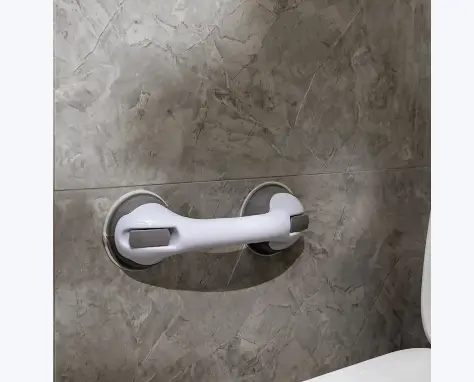
Unsuitable for: Matte tiles, antique tiles, latex paint walls, wallpaper, diatomaceous earth, tiles with gaps/hollow areas – they won’t stick and will fall off easily.
Users & Strength: Only for light leverage: Use it to stand up and stabilize your body; do not suspend yourself or pull forcefully.
Adults are not heavy, and it’s fine for temporary use by young people.
Product Qualification Standards:
Double suction cups, with rotating lock/pressure rod vacuum lock (not just simple pressing); suction cup diameter ≥12cm; labeled load capacity ≥120kg.
Risk Points:
Suction strength drops drastically when wet: Water film on the wall during showering disrupts the vacuum seal, significantly reducing suction strength; hot water steam softens the suction cup rubber, causing leaks and a high risk of detachment during showering.
Very low load capacity: The labeled load capacity of 150 catties is for static suction on a dry wall; with a wet, slippery surface, forceful pulling, or full body weight, the actual load capacity drops to half or even less.
Rubber aging: Prolonged exposure to hot water, shower gel, and cleaning agents can harden, crack, and lose its seal. Leaks may not be visible to the naked eye, but the suction cup may suddenly detach when held.
Air leakage from tiny wall gaps: Air can slowly seep into tile grout and small pits in the tile surface, gradually loosening the suction over several hours or days without many people noticing.
Air leakage from tiny wall gaps: High-risk groups should use with caution. Elderly people, pregnant women, those with hemiplegia, mobility issues, and those recovering from surgery are at high risk of fractures if they slip and fall. It is not recommended to install suction cup handrails alone.
How to improve the safety of suction cup handrails (temporary solution): Thoroughly clean tiles before installation, remove oil stains with alcohol, and allow to dry completely before suction. Choose a double vacuum lock model. After installation, shake it vigorously to test for looseness. Check for looseness before daily use.
Do not install directly under a shower head.
Inspect the suction cup silicone every 3 months; replace it immediately if it hardens, turns white, or cracks.
Do not use it for full-body suspending or pulling; use it only for auxiliary support. Advanced reinforcement: Use anti-slip adhesive pads and nail-free auxiliary stickers (not a long-term substitute for drilling).
Do suction cup handrails comply with ADA standards?
ADA Core Mandatory Requirements
The U.S. Access Board (ADA) standards have mandatory structural requirements for handrail anchors:
Anchoring must be permanent mechanical fixation.
Compliant handrails must be screwed/expansion anchors into the wall framing, solid backing, or concrete. Vacuum suction cups, nail-free adhesive, and snap-on bathtub handrails are not considered compliant anchoring methods; regulations do not recognize vacuum suction as a load-bearing fixing method.
Load-bearing test requirement: 250 lbs (≈113 kg) of continuous force in any direction without detachment or loosening.
The 300/350 lb rating for suction cups is the ideal static value for dry, smooth tiles; bathroom moisture, temperature differences, and micro-gaps in the tiles will slowly leak air, significantly reducing the actual load-bearing capacity in a wet state, making it impossible to consistently pass the ADA continuous load test.
ADA requires handrails to withstand the full weight of a person and the impact load of a fall; suction cups cannot withstand sudden pulling or slippery, weightless impacts, posing a risk of unannounced detachment.
Long-term stability requirements: ADA applies to public bathrooms, nursing homes, hotels, and medical facilities, requiring handrails to remain functional under high-frequency, year-round use; suction cup silicone ages and loses its seal when exposed to hot water and shower gel, failing to meet long-term commercial durability standards.
Compliant alternatives (truly ADA compliant): Drilled stainless steel handrails (the only fully compliant): Screw-fixed to a joist/solid wall, stable in both wet and dry conditions, passed a 250-pound omnidirectional load test.
Bathtub clip-on metal handrails (non-suction cup): Mechanically locked to the bathtub edge, some medical models reach 300 pounds load capacity, only a temporary alternative for bathtubs, but still does not meet ADA requirements for wall-mounted shower areas.
High-strength nail-free adhesive metal handrails: Industrial structural adhesive + mechanical anchoring to a metal base, some models pass load tests, and in some areas, Retrofit retrofits can replace drilling, superior to suction cups.
Are suction cup handrails safe for the elderly?
Why are the risks of suction cup handrails for the elderly far greater than for younger people?
1. Completely different force distribution: Elderly people often have weak legs and poor balance. When they stand up or slip, their entire weight pulls forcefully on the handrail, not just a light touch.
ADA standards require handrails to withstand a continuous impact force of 250 pounds. When the suction cup is wet or steamy, its suction power is halved.
Greasy tile gaps, moisture, and the slippery film from shower gel can cause the suction cup to slowly leak air. This leak may not be visible to the naked eye, but it can easily detach with force, greatly increasing the risk of fractures and brain hemorrhage in elderly people who fall.
2. Environmental factors continuously damage suction power (bathrooms are high-risk environments): Hot water and steam from showers soften the silicone of the suction cup. Shower gel and limescale seep into the contact surface, continuously worsening the seal.
The silicone will harden and crack within 1-3 months, significantly reducing suction power. Many families do not regularly check and replace them.
3. Elderly people have slower reaction times and weaker self-rescue abilities. While young people can maintain their balance even if a handrail slips, elderly people, with their fragile bones and slow recovery of balance, are more prone to falls and serious injuries.
4. Susceptibility to adhesion to slightly imperfect walls. Antique tiles, matte tiles, textured tiles, hollow tiles, and tiles with wide grout lines make it impossible for suction cups to create a stable vacuum, rendering them unsuitable for most older bathrooms.